Most leadership training tells you what to do. Almost none of it tells you who you are.
I work with Catholic executives, dioceses, universities, schools, and lay apostolates on leadership formation grounded in a coherent account of the human person. The work is theological, empirical, and practical, in that order.
Transcendent Orientation and Discernment
Justice and Stewardship of the Common Good
Prudential Self-Governance
Formation is not training with prayer added at the beginning.
Catholic organizations are well served for networking and business coaching. They are poorly served for anything that answers the prior question: what is a person for, and what does that mean for the one who leads?
My work draws on the Catholic Christian Meta-Model of the Person (Vitz, Nordling, and Titus, 2020), a framework that treats the human being as created, wounded, redeemed, and ordered toward a real end. Applied to leadership, it reframes the whole enterprise. Virtue is not a soft skill. Discernment is not intuition. The common good is not stakeholder theory in a cassock.
Alongside the theology sits original research: an IRB-approved qualitative study of Catholic leaders across ministry, healthcare, education, construction, and the military; a published factor-analytic study of leadership character and the Short Dark Triad; and the ongoing development of the Flourishing Leadership Scale. The claims I make about formation are claims I have tried to measure, and I say plainly where the measurement is not yet finished.
Eight ways this work enters an organization.
These are starting points rather than a catalog. Most engagements combine two or three. Tell me the group and the time you have, and I will tell you what actually fits.
Keynote
A single argument delivered well: why leadership formation without an anthropology of the person produces competent people who are not becoming anyone in particular.
Workshop
Working sessions on discernment, prudential judgment, and the ordering of work to vocation. Case-based, with structured reflection built in.
Executive retreat
Silence, conferences, and guided examination for leaders carrying real weight. Built to be spiritually serious, not a strategy offsite with a chaplain attached.
Faculty and school formation
Formation for the people who form students. Built around vocation, authority held as a trust, and the ordering of a school's work to the end of the person. Runs as a single in-service, a leadership-team series for presidents and principals, or a year-long path with a diocesan office.
Book study
A chapter-per-month formation path for existing groups, with discussion questions, practices, and a facilitator script. Runs with or without me in the room.
Flourishing Leadership debrief
A structured examination for leaders organized around the three dimensions of the Scale. Formative rather than diagnostic: the instrument is in active validation and is not used for selection, placement, or prediction.
Leadership cohort
The full arc. Monthly formation, peer accountability, mentorship structure, and an individual rule of life for leadership. This is where the work actually changes people.
Advisory
Limited advisory work on leadership formation programs, institutional mission and Catholic identity, and how an organization develops the people it promotes. I take a small number of these, and only where the question is formational rather than operational.
Tell me who is in the room, roughly how many, and how much time you have. I will tell you what fits and whether this is the right work for your group.
What twenty readers are saying
"A new classic. It is essential for anyone with an interest in leadership."Paul C. Vitz, PhD — Professor of Psychology Emeritus, Divine Mercy University; author, A Catholic Christian Meta-Model of the Person
"This work is an important contribution to the understanding of what makes Catholic leadership distinctive and different from other approaches… It should be mandatory reading for anyone in a leadership position in a Catholic institution."Tracey Rowland, PhD — St. John Paul II Chair of Theology, University of Notre Dame Australia; Member, Pontifical Academy of Social Sciences
"The book demands integration, not tips. It is not for readers looking for shortcuts; it is for leaders serious about forming themselves and building cultures where people flourish."Andreas Widmer — Professor, The Catholic University of America; Director, Ciocca Center for Principled Entrepreneurship
"Rather than baptizing secular leadership theories, he asks the more fundamental question: Who is the person who leads? That difference changes everything."Adam J. Dufault, EdD — Superintendent of Catholic Schools, Diocese of Columbus
"Dr. Ewing writes with the insight of a scholar, the experience of a leader, and the heart of a Catholic man attentive to the dignity of the human person… This book moves beyond technique and efficiency to the deeper question of who a leader is becoming before God."Bishop Robert P. Reed — Rector, St. John’s Seminary; President and CEO, CatholicTV Network and iCatholic Media
"By anchoring leadership development in a rigorous Thomistic foundation, this book brilliantly bridges modern empirical psychology and the timeless truths of Christian anthropology."Andrew V. Abela, PhD — Dean, Busch School of Business, The Catholic University of America
All twenty endorsers
The Flourishing Leadership Scale
The FLS is an instrument under development to measure dispositions toward flourishing in leadership from within a Catholic understanding of the person. An initial study established a three-dimension structure. A second study with an independent and more religiously diverse sample of Christian leaders supported the broad structure, identified one item for revision, and showed that the prudential dimension does not yet hold together well enough to stand on its own. That dimension is being rebuilt.
It is not a personality type indicator and it is not a substitute for one. It does not sort people into categories, and at this stage of validation it should not be used for hiring, placement, or performance decisions. What it does well is give a leader and a formator a shared, disciplined vocabulary for a conversation that usually happens in vague terms or not at all.
Organizations willing to host a validation sample are welcome to reach out. Participation is anonymous, takes about fifteen minutes, and gives your group early access to the debrief materials.
Spirit of Wisdom Press
Called to Lead
Most leadership books ask what a leader should do. This one asks the question underneath it: who is the leader becoming while he leads?
It begins with the human person, created in the image of God, called by name, and entrusted with responsibility for others. From there it builds outward: vocation, virtue, discernment, authority held as a trust rather than a possession, the dignity of those who are led, suffering, prayer, and the way different states in life shape the exercise of leadership. It is a formation book rather than a management manual, and it is written to be worked through slowly, with reflection sections at the end of every chapter that are the point rather than an appendix to it.
The argument is grounded in the Catholic Christian Meta-Model of the Person and in original research: an IRB-approved qualitative study of Catholic leaders across ministry, healthcare, education, construction, and the military, and the development of the Flourishing Leadership Scale. Twenty readers, including a bishop, two seminary rectors, a mother general, three university deans and professors, a diocesan superintendent, and the leaders of three national Catholic organizations, have read the manuscript and endorsed it.
With a foreword by Rev. Charles Sikorsky, LC, President of Divine Mercy University.
- Transcendent Orientation and DiscernmentLeadership rooted in prayerful vocation rather than ambition.
- Justice and Stewardship of the Common GoodAuthority exercised as a trust rather than a possession.
- Prudential Self-GovernancePractical wisdom and virtuous self-governance in everyday decisions.
The framework carries into a room. It runs as a leadership retreat, a faculty in-service, a workshop for an executive team, a six-to-eight session book study, or a year-long cohort. The chapter reflections are built to serve as the spine of any of these.
Called to Lead is available now in paperback from Spirit of Wisdom Press, $21.95. ISBN 978-1-968630-05-8. Bulk pricing is available for parishes, schools, dioceses, and formation programs; use the contact form below and I will put you in touch with the publisher.
Divine Mercy University featured the book as an application of the Catholic Christian Meta-Model of the Person to leadership. Read the feature
Written for practitioners, argued for scholars.
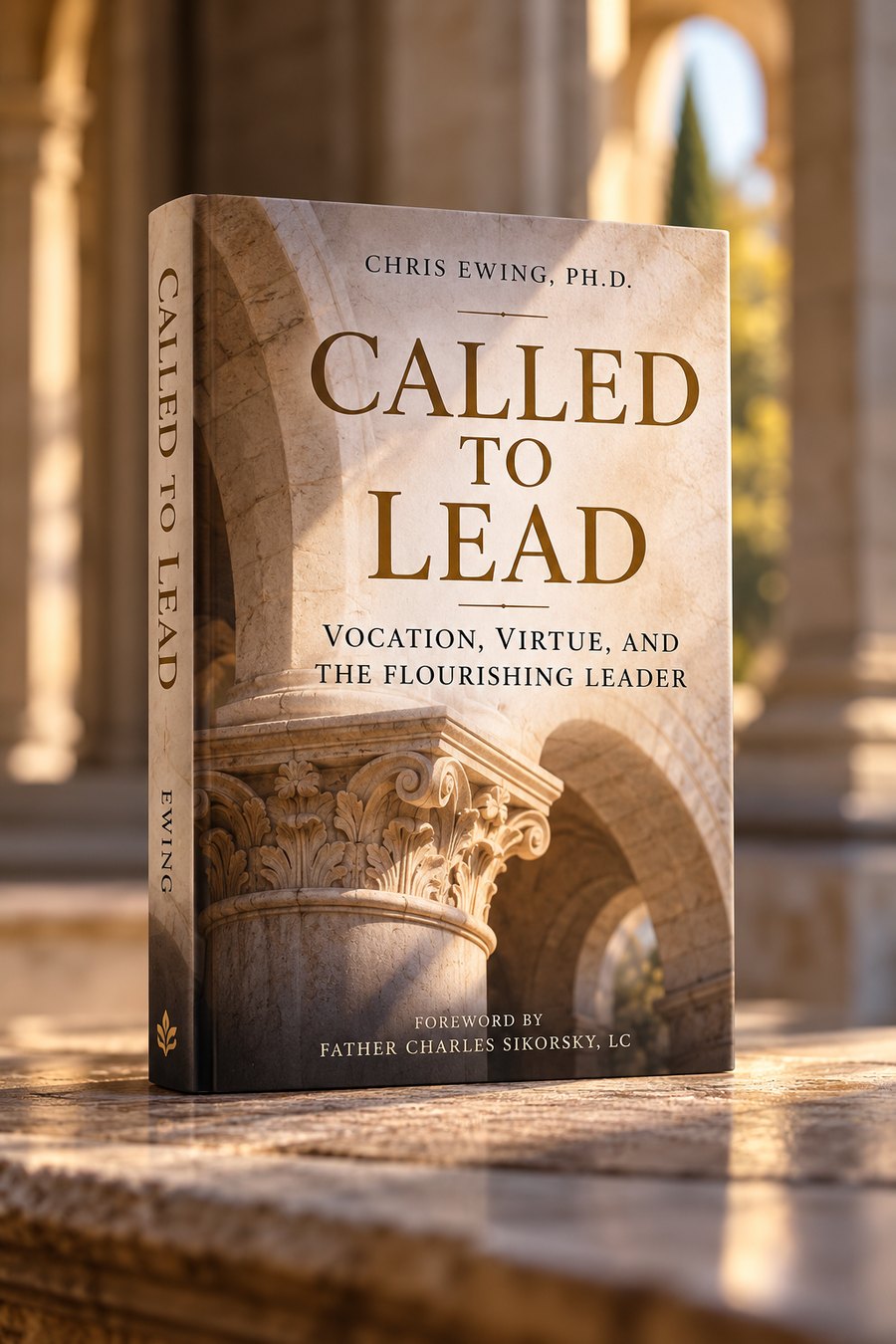
Called to Lead
A formation book grounded in the Catholic Christian Meta-Model of the Person, original qualitative research with Catholic leaders, and the Flourishing Leadership Scale. Foreword by Rev. Charles Sikorsky, LC, President of Divine Mercy University.
Order from Spirit of Wisdom Press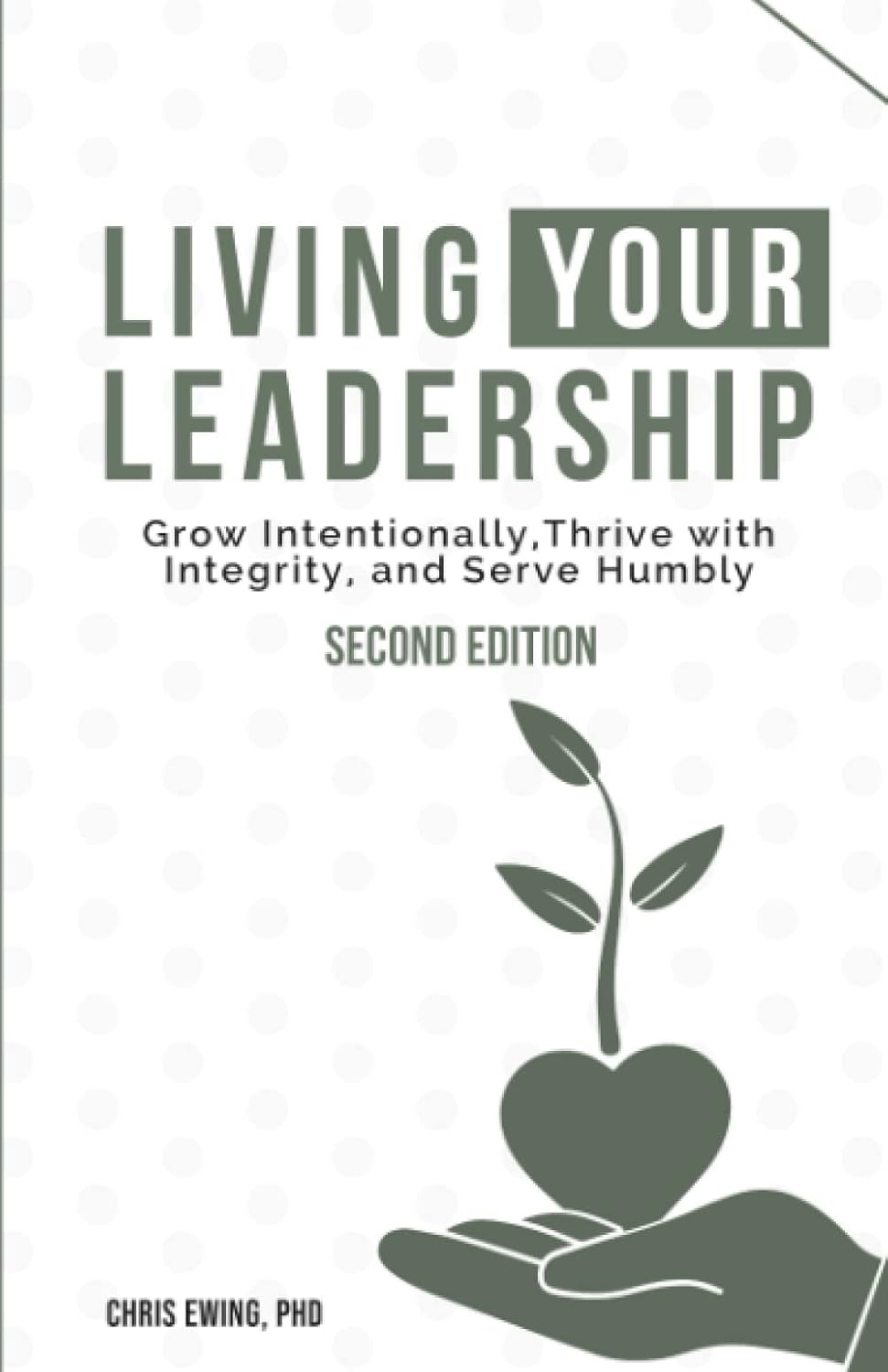
Living Your Leadership
A practitioner's text on leading from character rather than technique. The first half is about leading yourself: self-knowledge, self-regulation, integrity, and the slow move from extrinsic to intrinsic motivation. The second half turns outward to humility, authenticity, and service. Written for working leaders, footnoted for those who want to go further.
Buy on AmazonChristopher J. Ewing, PhD
I am an educational psychologist who spent eight years as an officer in the United States Air Force, first in space and missile operations and later as an electronic warfare officer deployed to Mosul, Iraq. I moved from there into healthcare and federal operations, where I led award-winning biomedical engineering teams and ran critical clinical call centers and other large-scale contact operations. I currently direct an international IT program. I teach because the questions that matter most in leadership are not operational ones.
I hold a PhD in Educational Psychology from Capella University, an MA in Adult Education from Central Michigan University, and a BA in English from Saint Louis University, where I entered the Church. I serve as Associate Professor and doctoral chair at Touro University Worldwide and teach leadership and applied psychology at Divine Mercy University. I am a Fourth Degree Knight and past Grand Knight of two councils, and a lector, sacristan, and cantor in my parish and cathedral.
My wife Missy and I have four children, two born to us and two adopted from foster care. In 2014 I donated a kidney. Those two facts have taught me more about the human person than any degree I hold, and they are the reason I find the language of self-gift more useful than the language of influence.
-
Appointments
- Associate Professor and Doctoral Chair, Touro University Worldwide
- Director, Health Sciences Program, Touro University Worldwide
- Adjunct Faculty, Psychology and Leadership, Divine Mercy University
- Board of Directors, Young Catholic Professionals
-
Credentials
- PhD, Educational Psychology
- Project Management Professional (PMP)
- Lean Six Sigma Black Belt
- Member, Society for Military Psychology, APA Division 19
- Peer reviewer, Universal Journal of Management and Journal of Higher Education Management
-
Recent speaking
- CAPS Conference, Ohio, on the Flourishing Leadership Scale
- Naples Classical Academy
- Touro University Worldwide Colloquia
- Lumen Conference, Washington, DC
- Guest lecturer, Florida State University
Tell me about your group.
The most useful first message includes who the participants are, roughly how many, what time you have available, and what you are hoping changes as a result. I will tell you honestly whether this work is the right fit.
Or write to me directly at chris@vocationandvirtue.org · Schedule a call · LinkedIn